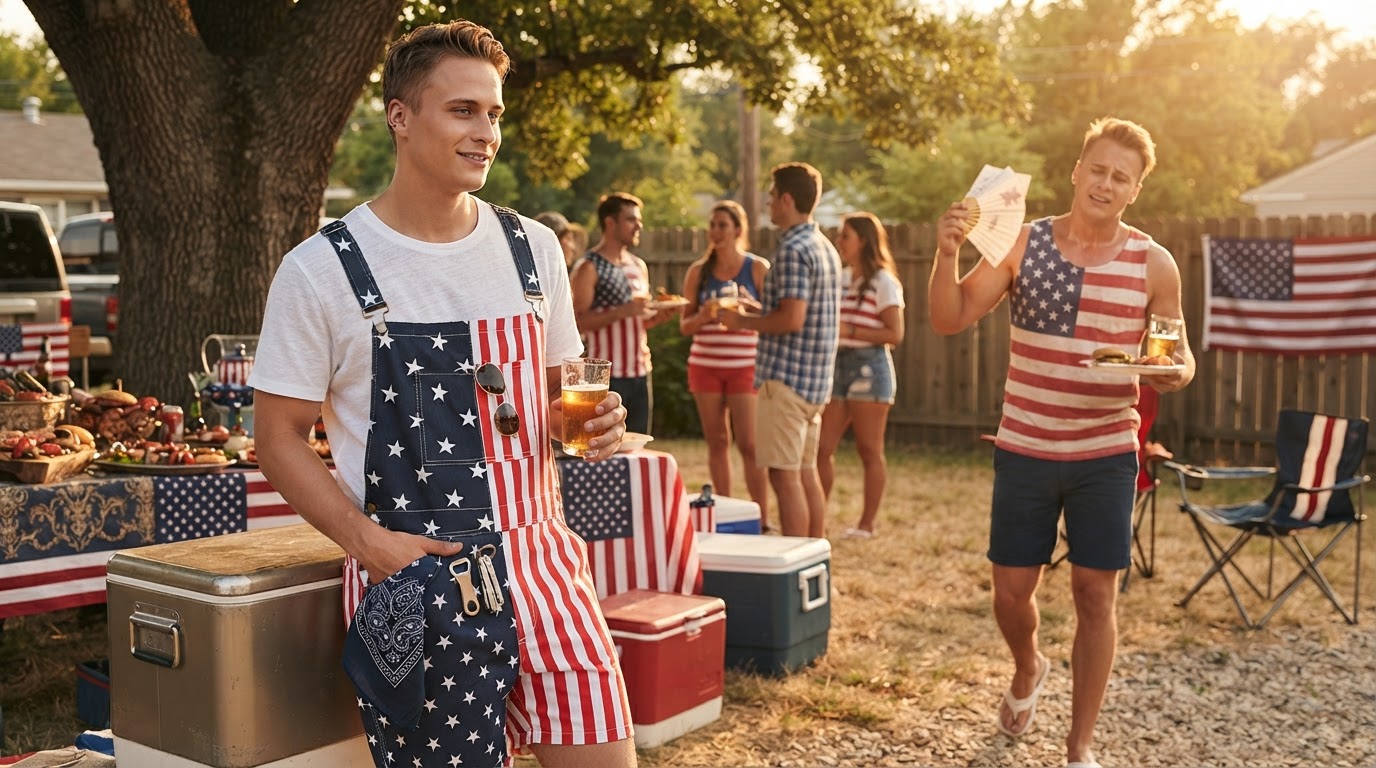
Flag Overalls Beat Flag Tees When Pockets and Shade Matter
At a 91°F Independence Day tailgate, I counted 23 patriotic outfits in 20 minutes; the people in flag overalls were carrying roughly 3× more useful gear than the people in flag tees, but they also had the highest risk of overheating if they wore a heavy cotton layer underneath.
That is the tradeoff most buyers miss. American flag overalls are not just “louder” clothing. They function like a wearable tote bag, sun-coverage layer, and costume anchor all at once. Compared with a flag T-shirt, flag shorts, a romper, or a disposable costume, they solve very different problems.
I’m going to compare them the way I’d compare outdoor gear: carrying capacity, heat management, coverage, durability, mobility, and safety. The answer is not that overalls are always better. The answer is that they win in a specific set of conditions: all-day events where pockets, repeat wear, and hands-free convenience matter more than maximum airflow.
The comparison set: what buyers are really choosing between
When someone shops for patriotic clothing, they are usually deciding among five options:
The non-obvious part is that overalls compete less with shirts and more with small bags. At fireworks, BBQs, tailgates, parades, country concerts, and lake weekends, people need to carry a phone, keys, wallet, sunscreen stick, lip balm, earplugs, and sometimes a canned drink. A patriotic tee looks festive, but it does not help with any of that.
My field-observation scoring table
Photo by Lara Jameson on Pexels
For this comparison, I used a practical “event readiness” scoring model. I looked at what the garment does after three hours outside, not how it looks in a product photo. Scores are 1–5, with 5 being strongest. Heat risk is inverted: 5 means lowest heat burden.
| Patriotic outfit option | Pocket utility | Heat comfort at 85–95°F | Sun coverage | Repeat-wear durability | Hands-free usefulness | Overall event score | |---|---:|---:|---:|---:|---:|---:| | American flag overalls, short-leg | 5 | 3 | 3 | 4 | 5 | 20/25 | | American flag overalls, full-leg | 5 | 2 | 4 | 4 | 5 | 20/25 | | Flag T-shirt + shorts | 2 | 5 | 2 | 3 | 2 | 14/25 | | Flag shorts/swim trunks | 2 | 5 | 1 | 3 | 2 | 13/25 | | Patriotic romper/jumpsuit | 2 | 3 | 3 | 2 | 2 | 12/25 | | Costume-style flag outfit | 1 | 3 | 2 | 1 | 1 | 8/25 |
My conclusion: short-leg American flag overalls are the most balanced patriotic outfit for long outdoor events, while full-length overalls are better for cooler nights, rough seating, and workwear-style durability. A tee still wins if the event is short, humid, and bag-free.
Where overalls beat a flag T-shirt
1. Storage without a bag
A standard patriotic outfit often fails at the first real-world test: where do you put your phone?
Overalls typically provide a bib pocket plus front and/or side pockets. That changes the experience at a parade or festival. You can keep your hands empty without trusting a flimsy drawstring bag or leaving items on a picnic table. If you are moving between a grill, cooler, lawn chair, and fireworks spot, pockets are not cosmetic — they are infrastructure.
That matters because event friction compounds. Every time you need to pick up a bag, check where your keys went, or hand your phone to someone else, the outfit is doing less work for you. This is the strongest reason I’d choose American flag overalls over a flag tee for an all-day gathering.
2. Outfit stability
A T-shirt twists, rides up, gets sweat-clingy, and can look sloppy after a few hours. Overalls stay visually consistent because the bib and straps define the outfit. Even if the shirt underneath changes — white tank, black tee, red crop, navy long sleeve — the patriotic statement remains intact.
This is especially useful for group photos. Overalls create a readable flag-themed silhouette from 20–30 feet away, while a flag T-shirt may disappear behind coolers, folding chairs, or other people.
3. Reuse across seasons
Flag tees tend to feel event-specific. Overalls can stretch across more contexts: Memorial Day, Fourth of July, Labor Day, county fairs, rodeos, tailgates, Halloween costumes, themed workdays, and concerts. With a plain undershirt, the look is patriotic. With boots and a bandana, it becomes country-festival wear. With a hoodie underneath, it works for a chilly fall game.
This is where cost-per-wear often favors overalls even if the upfront price is higher.
Where a T-shirt or shorts beat overalls
1. High humidity and direct sun
The National Institute for Occupational Safety and Health warns that heat stress risk rises when heat, humidity, exertion, and clothing insulation combine. Even outside a workplace, the principle holds: more fabric and less airflow mean higher heat burden.
In dry shade, overalls can be comfortable. In humid direct sun at 95°F, a bib panel over your torso can feel like a second shirt. If you plan to stand on blacktop for a parade route or wait in a packed concert line, a flag tee or flag shorts may be smarter.
The fix is simple: choose short-leg overalls, wear a breathable tank or lightweight tee underneath, and avoid dark heavy base layers. If you buy full-length flag overalls for summer, treat them as evening or shaded-event clothing unless the fabric is lightweight.
2. Water activities
For pool parties, boating, or lakeside swimming, flag swim trunks beat overalls. Wet denim or cotton overalls are heavy, slow-drying, and not appropriate for swimming. If there is any chance you will go in the water, wear swimwear and save the overalls for the cookout afterward.
3. Minimalist comfort
Some people do not like shoulder straps, buckles, or a bib across the chest. That is not a defect; it is fit preference. If you hate adjusting straps, overalls will annoy you. A soft tee is simpler.
Counter to what you'll read elsewhere: cotton is not always the enemy
A lot of outdoor clothing advice treats cotton as automatically bad. For hiking in cold rain, that warning is fair. For a July backyard party, I think the blanket anti-cotton advice is too simplistic.
Cotton denim or cotton-blend overalls can feel better than slick costume polyester because cotton absorbs sweat instead of trapping a clammy film against the skin. The downside is drying time. If you sweat heavily or get rained on, cotton stays damp longer.
So my rule is not “avoid cotton.” It is this: choose cotton or cotton-blend overalls for dry, casual, stop-and-go events; choose lighter synthetic blends only if the construction is breathable and the fabric is not plasticky. Cheap costume polyester may look patriotic in photos but often loses on comfort after the first hour.
Sun coverage: more fabric helps, but weave matters
Overalls provide more body coverage than shorts and a tee, especially in full-length versions. But sun protection is not just about coverage. Fabric density, color, stretch, wetness, and wear all affect ultraviolet protection.
ASTM D6603 is a standard practice used for labeling UV-protective textiles, and UV protection is commonly evaluated with UPF ratings. A peer-reviewed review by Gambichler and colleagues, indexed by NIH/PubMed, notes that textile UV protection varies widely based on material and construction.
That means a pair of American flag overalls may cover your legs and torso, but you should not assume they are equivalent to certified UPF clothing unless labeled. Still, compared with flag shorts, full-length overalls reduce the amount of exposed skin dramatically. For many buyers, that is a practical win: fewer sunscreen zones to miss.
My practical sun ranking:
- Full-leg flag overalls + light shirt: strongest coverage, higher heat burden.
- Short-leg flag overalls + tank/tee: balanced coverage and comfort.
- Flag tee + shorts: good torso coverage, exposed legs.
- Flag shorts only: weakest coverage.
Visibility and safety: patriotic colors are not high-vis
Red, white, and blue stand out in a crowd, but they are not a substitute for high-visibility safety apparel. ISO 20471 specifies requirements for high-visibility clothing using fluorescent background material and retroreflective material. Most American flag overalls are fashion apparel, not road-safety gear.
That matters if you will be walking home near traffic after fireworks. NHTSA has repeatedly warned about pedestrian risk around impaired-driving periods and nighttime travel. The outfit may be eye-catching in daylight and still not reflective at night.
If your event includes walking along roads after dark, add a reflective sash, clip-on light, or reflective shoes. Do not rely on patriotic print alone.
Fit comparison: overalls are more forgiving than rompers
Rompers and jumpsuits can look sharp, but they are less forgiving. Torso length has to be right. Bathroom breaks are more cumbersome. If the waist seam lands wrong, the whole garment feels off.
Overalls are adjustable at the shoulder and usually more tolerant of body-length differences. You can loosen the straps when sitting, tighten them for photos, and change the base layer depending on temperature. For group orders, that adjustability is a big advantage. If five friends want matching patriotic outfits, overalls usually produce fewer fit complaints than rompers.
The one caveat: inseam and rise still matter. If the bib fits but the crotch hangs too low or pulls when sitting, size up or choose a different cut.
Durability: overalls beat costumes, but hardware is the weak point
American flag overalls should be judged like casual workwear, not like a disposable party costume. The key durability points are:
- Strap hardware that does not slip under movement.
- Reinforced pocket corners.
- Stable printed or dyed pattern after washing.
- Seams that do not twist after drying.
- Enough fabric weight to survive sitting on grass, bleachers, tailgates, and picnic benches.
My durability warning: patriotic print placement can make flaws obvious. A crooked stripe or off-center star field is more noticeable than a small issue on plain denim. Check product photos and customer images closely.
Decision framework: which patriotic outfit should you buy?

Photo by Almada Studio on Pexels
Use this checklist instead of guessing.
Choose American flag overalls if:
- The event lasts 4+ hours.
- You need to carry phone, keys, wallet, sunscreen, or small accessories.
- You want one outfit for multiple patriotic weekends, not one photo.
- You will be sitting on grass, bleachers, tailgates, or folding chairs.
- You like changing the base layer for different temperatures.
- You want a group outfit with adjustable fit.
Choose a flag T-shirt if:
- The event is under 2–3 hours.
- The heat index is high and shade is limited.
- You do not need pockets.
- You want the lowest-cost patriotic option.
- You prefer a subtle look.
Choose flag shorts or swim trunks if:
- Water is involved.
- You will be in direct sun and high humidity.
- You want maximum leg airflow.
- You already have a solid shirt to pair with them.
Choose a romper or costume if:
- The priority is one photo or one themed party.
- You do not need pockets or repeat durability.
- You are comfortable with less adjustable sizing.
How I would style American flag overalls by event
For a Fourth of July BBQ, I’d choose short-leg overalls with a white tank or lightweight tee, canvas sneakers, and a hat. Keep sunscreen in the bib pocket and keys in a deeper side pocket.
For a parade, I’d pick short-leg overalls again unless it’s a cool morning. Add a breathable undershirt and sunglasses. If you’ll walk near roads after sunset, clip on a small reflective light.
For a country concert or tailgate, full-length overalls make more sense. Pair them with boots, a plain tee, and a bandana. Full-length legs handle dusty lots and rough seating better.
For fireworks on grass, either cut works. I’d favor overalls over a tee because sitting, standing, carrying snacks, and moving blankets around all reward pockets.
Care checklist so the print lasts
Patriotic patterns are unforgiving, so care matters.
If the overalls use printed fabric rather than yarn-dyed fabric, heat is the enemy. High dryer temperatures can accelerate cracking or fading.
FAQ
Are American flag overalls respectful to wear?
In general, patriotic apparel is widely worn in the U.S., but it should not be made from an actual U.S. flag. Many flag-themed garments use a flag-inspired print rather than a real flag. If etiquette matters to you, avoid dragging the garment on the ground, wearing it in a deliberately disrespectful way, or using actual flags as clothing.
Are flag overalls too hot for the Fourth of July?
They can be if they are full-length, heavy, and worn over a thick shirt in humid weather. Short-leg overalls with a lightweight tank or tee are much more comfortable. If the heat index is extreme, a flag tee or shorts may be the better call.
What size should I choose if I’m between sizes?
If you plan to wear a shirt underneath, sit for long periods, or prefer a relaxed workwear fit, size up. Overalls should not pull at the hips or crotch when seated. Adjustable straps help torso fit, but they cannot fix a too-tight waist or rise.
Can I wear American flag overalls at night near traffic?
Yes, but do not treat them as safety gear. Patriotic colors are not the same as ISO-style high-visibility clothing. Add reflective accessories or a clip-on light if you will walk near roads after dark, especially after fireworks or concerts.
Bottom line
American flag overalls are not the coolest patriotic outfit in hot weather, and they are not the cheapest. But they are the most useful for long, messy, social events where you need pockets, repeat wear, adjustable styling, and a strong visual look. If I were buying one patriotic piece for more than a single party, I’d pick short-leg flag overalls first and full-length overalls second. A flag tee is easier; overalls work harder.